By Kate Coldrick, Inclusive Education Tutor and Writer
When I first wrote Learning Where You Live for my personal blog, my goal was simple: to show how local surroundings can become structured, sensory classrooms for autistic and neurodivergent learners. The lanes, church tower, and heathland of Woodbury offered endless prompts for language, calm observation, and belonging.
But I quickly realised that the same principle could help families far beyond Devon. Many parents of neurodivergent children who are home educating look for practical ways to turn daily life into learning. That reflection became the starting point for my new TES resource: Learning Where You Live – Woodbury Devon Local Learning Ideas for Parents.
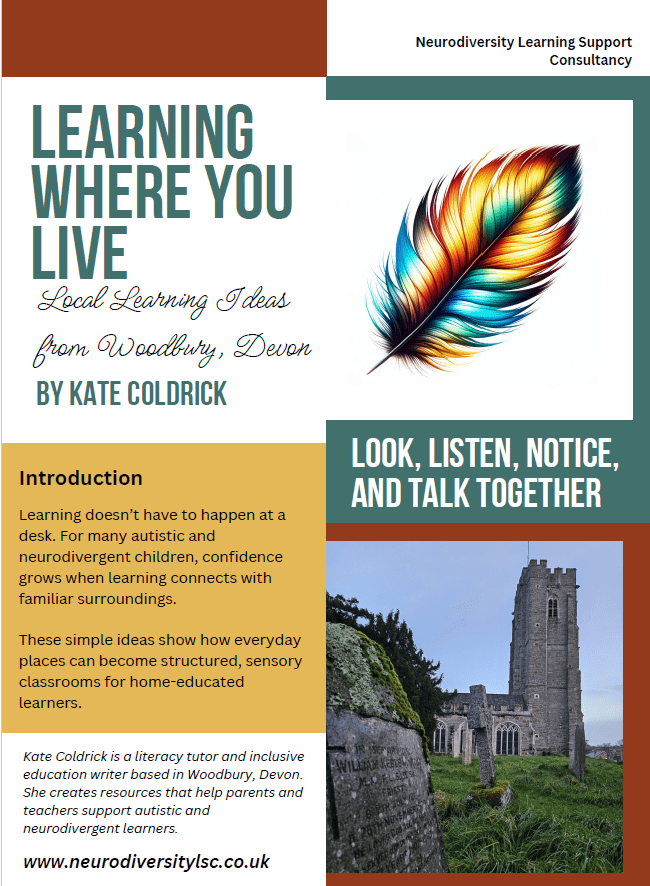
Turning reflection into a resource
Translating a blog post into a printable resource meant changing tone and structure. The blog was a personal piece about place and inclusion; the TES pack needed to be visual, accessible, and activity-based. Each page now follows the same rhythm of learning: observe, describe, extend.
The resource contains a collection of short sections drawn from familiar places around Woodbury – the Post Office sign, the thatched cottages, St Swithun’s Church, and the wide sky over Woodbury Common. Each activity starts with observation and sensory awareness before extending into literacy, numeracy, or reflective writing.
I kept the examples local, but wrote them so they can be adapted anywhere. The aim is to help parents use what’s already around them – a walk, a shop window, a patch of sky – to build confidence and connection in learning.
Why place matters in inclusive learning
For many autistic learners, safety and predictability are the foundations of learning. Familiar places reduce cognitive load and free up energy for communication and problem-solving. Using the local environment also bridges the gap between abstract tasks and real-world meaning: reading signs becomes literacy, counting gates becomes maths, and noticing patterns in nature becomes the start of descriptive language.
When parents begin to see learning opportunities woven through their own routines, education feels less like something that happens elsewhere and more like part of daily life.
Designing the TES version
Creating the TES resource was a way to make these ideas more practical and shareable. Each page includes photos, brief activities, and optional extensions. The pack covers literacy, numeracy, sensory description, and even introductions to history and science through Woodbury’s church and Common.
By publishing on TES, I wanted to model how inclusive education materials can emerge from lived experience. Local observation becomes global learning in a pattern that any tutor, teacher, or parent can replicate.
A tailored service for parents
I now offer this same approach as a personalised consultancy service for parents of neurodivergent children who are home educating. Working together, we can design a set of bespoke “Learning Where You Live” suggestions tailored to your own locality.
That might include:
- identifying local spaces that support calm, sensory learning;
- creating activity ideas linked to literacy, numeracy, or creative writing;
- adapting the structure to your child’s strengths and interests;
- building a flexible plan that fits real routines rather than formal lessons.
These tailored guides help families rediscover learning in the familiar, turning everyday surroundings into inclusive spaces for growth.
Read and download
You can read the original reflection on my blog at katecoldrick.com
and download the full TES pack here:
Learning Where You Live – Woodbury Devon Local Learning Ideas for Parents (by Kate Coldrick)
I also share regular photographs and short prompts from around Woodbury, Devon on Instagram, showing how everyday places can become structured, sensory starting points for learning.
For more information about bespoke learning suggestions for home-educating families, contact me via the Neurodiversity Learning Support Consultancy.
Kate Coldrick is an educator, researcher, and inclusive learning specialist based in Woodbury near Exeter. She supports schools, families, and home-educated learners through consultancy, training, and resources on neurodiversity and inclusive practice.
 Kate Coldrick – Home Education Consultant for Neurodivergent Learners